
Tree Service in Mesquite, TX: Removal, Trimming and Stumps
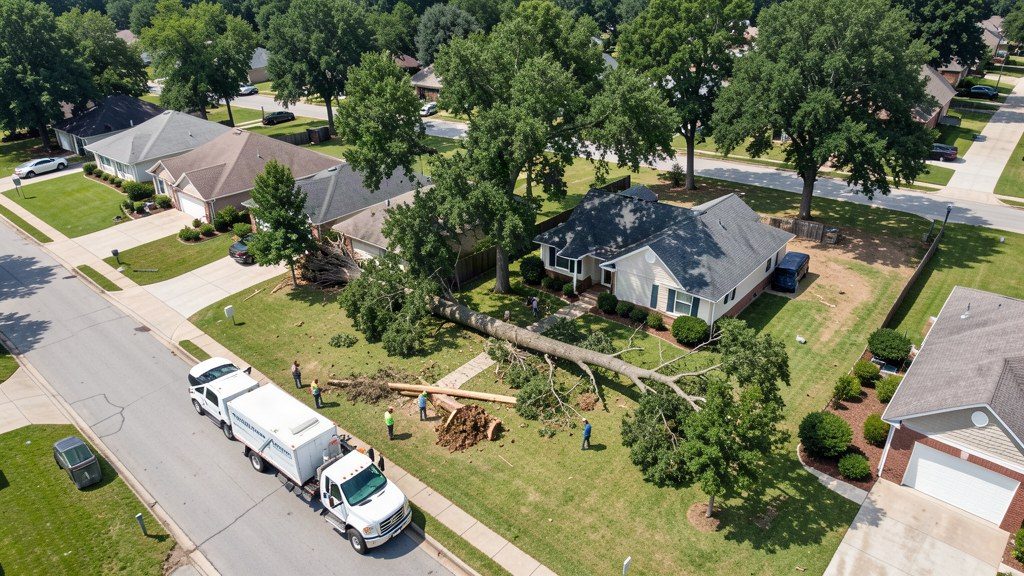
Mesquite's 1960s and 70s subdivisions off Town East and Galloway were planted with hackberry, cedar elm and Arizona ash because they grew fast. Fifty years on, those same trees are the ones declining, dropping limbs, and leaning over roofs, and a lot of our work in Mesquite is deciding which ones to save and which to take down.
Tree conditions in Mesquite
Aging hackberry and ash
Both are short-lived species that were planted by the thousands. Ash has the added problem of emerald ash borer, which has been confirmed in Dallas County, so a declining ash gets inspected for exit holes and canopy dieback before we recommend anything.
Rear utility easements
Many Mesquite lots have overhead lines along the back fence. We prune to safe clearance on the tree's side; anything in contact with primary lines is the utility's job and we tell you who to call.
Creek lots
Homes along Duck Creek and South Mesquite Creek lose bank soil in heavy rain, which undercuts roots and starts a lean toward the water or the house.
What we handle in Mesquite
- Removal of declining ash and hackberry
- Deadwood and weight reduction over roofs and driveways
- Stump grinding for stumps left from earlier removals
- Storm limb cleanup and hangers
- Cabling for trees worth keeping that have a weak union
Mesquite is in Dallas County. We also work in Balch Springs, Garland, Sunnyvale, Forney. Pricing for removal in this area is based on tree size, access, and species — typical removal ranges from $300 to $3,200 depending on the situation.
Tree Species We Service in Mesquite
The most common trees in Mesquite include live oaks, red oaks, cedar elms, pecans, hackberries, crape myrtles, and Bradford pears. Our certified arborists are trained on these species and their specific disease risks in North Texas.
Common Problems We See
live oak
Live oaks are the signature Dallas tree — massive, evergreen, and prone to oak wilt in spring.
red oak
Red oaks are highly susceptible to oak wilt and require careful pruning in dormant season.
cedar elm
Cedar elms are fast-growing but vulnerable to Dutch elm disease and ice-storm damage.
pecan
Pecan trees are native to the Trinity River bottomlands and grow very large very fast.
hackberry
Hackberries are common in East Dallas but susceptible to hackberry wilt and pest damage.
crape myrtle
Crape myrtles line many Dallas streets; they need summer watering and pruning after flowering.
bradford pear
Bradford pears are fast-growing, ice-prone ornamental trees common in older Dallas neighborhoods.
bois d'arc
Bois d'arc trees have extremely hard wood and are common as living fences in North Texas.
bald cypress
Bald cypress grows near water and is common along White Rock Creek and White Rock Lake.
mexican buckeye
Native understory tree found in Dallas creek bottoms; susceptible to buckeye rust.
Common questions from Mesquite homeowners
If it is declining and emerald ash borer is in the county, usually yes. We look for D-shaped exit holes, bark splitting and thinning at the top of the canopy first. A healthy ash can stay; a dying one is a hazard over anything under it.
We work the parts of the tree outside the utility clearance zone. Limbs touching or within reach of the primary lines have to be handled by the utility's contractor, and we will point you to the right request line.
Within a few inches in most cases. We grind six to eight inches below grade, pull the chips, and backfill with soil so the spot can be sodded or planted.
Need a tree crew in Mesquite?
Call or send a message for a free, no-obligation estimate.