
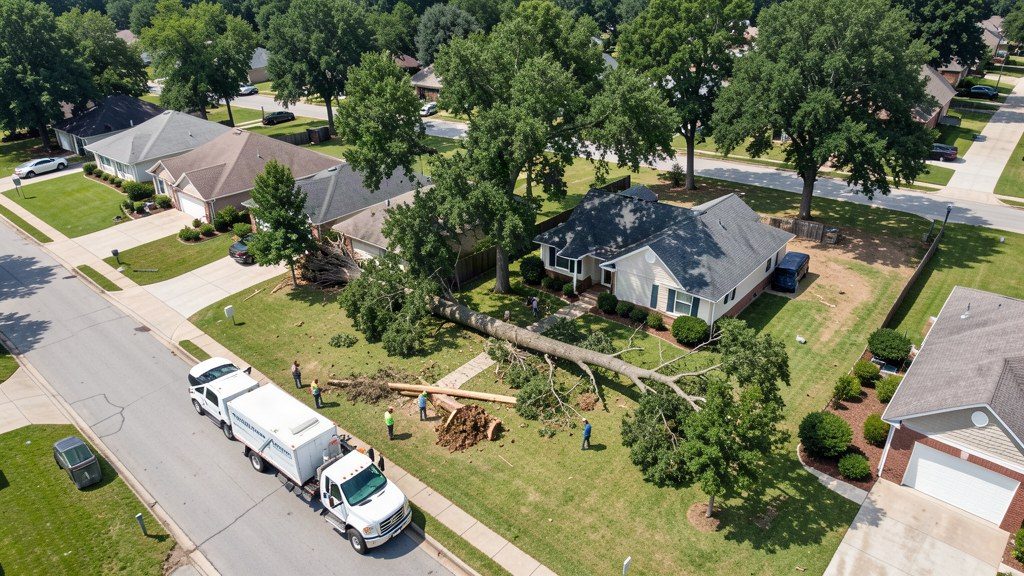
Tree Service in Grand Prairie, TX: Removal, Storm Work and Stumps
Grand Prairie stretches from older north-side neighborhoods near Dalworth and downtown to the Joe Pool Lake and Mountain Creek side, so a job here can be a 70-year-old pecan over a 1950s house or a fast-grown red oak in a 2010s subdivision. The soil changes across the city too, which changes how trees root and fail.
Tree conditions in Grand Prairie
Post oaks on the western edge
The west side of Grand Prairie picks up Cross Timbers sandy soil and native post oaks. Post oaks decline and die when their roots are cut, buried or overwatered, which is why they so often fail a few years after a patio or pool goes in.
Lake wind exposure
Lots near Joe Pool Lake and Mountain Creek Lake take more sustained wind. Trees with long limbs over the house on the lake side get reduced first.
Three counties, one city
Dallas, Tarrant and Ellis County lines all run through Grand Prairie. Utility providers and local rules can differ by address; we sort that out on the estimate.
What we handle in Grand Prairie
- Post oak assessment and removal
- Wind-damaged tree removal and hanger clearing
- Clearance pruning over roofs and pools
- Stump grinding on any side of the city
- Replacement planting suited to the soil on your side of town
Grand Prairie is in Dallas, Tarrant and Ellis Counties. We also work in Arlington, Irving, Duncanville, Cedar Hill. Pricing for removal in this area is based on tree size, access, and species — typical removal ranges from $300 to $3,200 depending on the situation.
Tree Species We Service in Grand Prairie
The most common trees in Grand Prairie include live oaks, red oaks, cedar elms, pecans, hackberries, crape myrtles, and Bradford pears. Our certified arborists are trained on these species and their specific disease risks in North Texas.
Common Problems We See
live oak
Live oaks are the signature Dallas tree — massive, evergreen, and prone to oak wilt in spring.
red oak
Red oaks are highly susceptible to oak wilt and require careful pruning in dormant season.
cedar elm
Cedar elms are fast-growing but vulnerable to Dutch elm disease and ice-storm damage.
pecan
Pecan trees are native to the Trinity River bottomlands and grow very large very fast.
hackberry
Hackberries are common in East Dallas but susceptible to hackberry wilt and pest damage.
crape myrtle
Crape myrtles line many Dallas streets; they need summer watering and pruning after flowering.
bradford pear
Bradford pears are fast-growing, ice-prone ornamental trees common in older Dallas neighborhoods.
bois d'arc
Bois d'arc trees have extremely hard wood and are common as living fences in North Texas.
bald cypress
Bald cypress grows near water and is common along White Rock Creek and White Rock Lake.
mexican buckeye
Native understory tree found in Dallas creek bottoms; susceptible to buckeye rust.
Common questions from Grand Prairie homeowners
Often not once major roots are cut or buried, but we assess before recommending removal. If the tree still has a chance we tell you what to stop doing to it and give it a season.
Yes. We rig so debris stays out of the water, cover the decking, and clean the pool area before we leave. It costs a little more time and saves a lot of cleanup.
All of Grand Prairie, north to south, whichever county your address falls in.
Need a tree crew in Grand Prairie?
Call or send a message for a free, no-obligation estimate.