
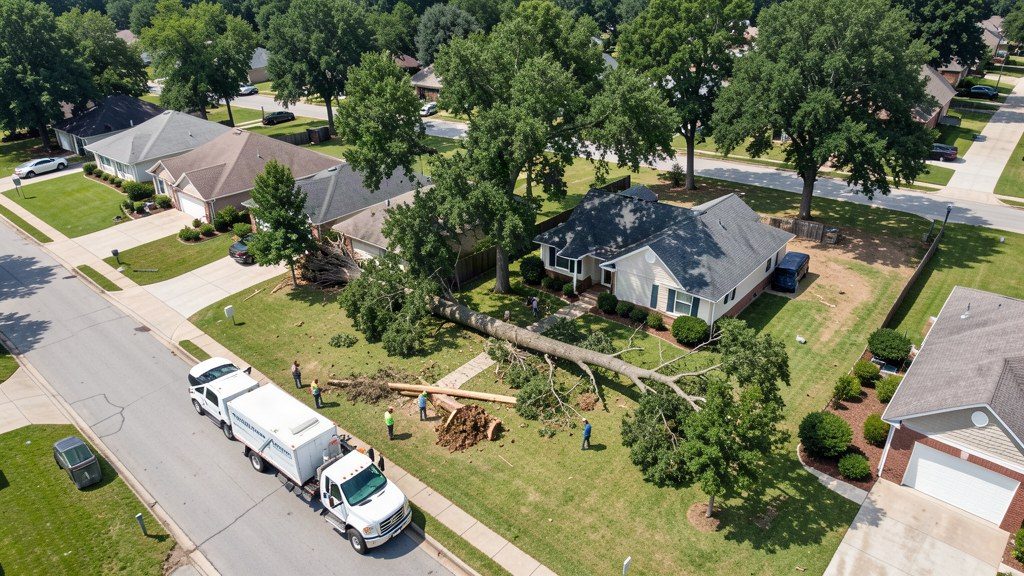
Tree Removal and Trimming in Arlington, TX
Arlington sits on the Eastern Cross Timbers, so many established neighborhoods have native post oaks and blackjack oaks on sandy soil alongside planted live oaks, pecans and cedar elms. The native oaks are the ones homeowners most want to keep and the ones most often killed by ordinary yard work.
Tree conditions in Arlington
Cross Timbers post oaks
Post oaks are slow growing and intolerant of root disturbance and heavy irrigation. A new lawn with sprinklers running over the root zone is a common reason a 100-year-old post oak starts dying.
Older central neighborhoods
The lots near UTA and downtown are tight, with big canopies over the house. Removals there are sectional and rigged, not felled.
Spring hail and wind
Arlington sits in the storm track. Hackberry and Arizona ash fail first, and the calls after a spring storm are mostly those two species on a roof or a fence.
What we handle in Arlington
- Hazardous and storm-damaged tree removal
- Post oak health assessment before anyone reaches for a saw
- Crown cleaning and deadwood over structures
- Storm cleanup, hangers and tarping
- Stump grinding
Arlington is in Tarrant County. We also work in Grand Prairie, Mansfield, Kennedale, Pantego. Pricing for removal in this area is based on tree size, access, and species — typical removal ranges from $300 to $3,200 depending on the situation.
Tree Species We Service in Arlington
The most common trees in Arlington include live oaks, red oaks, cedar elms, pecans, hackberries, crape myrtles, and Bradford pears. Our certified arborists are trained on these species and their specific disease risks in North Texas.
Common Problems We See
live oak
Live oaks are the signature Dallas tree — massive, evergreen, and prone to oak wilt in spring.
red oak
Red oaks are highly susceptible to oak wilt and require careful pruning in dormant season.
cedar elm
Cedar elms are fast-growing but vulnerable to Dutch elm disease and ice-storm damage.
pecan
Pecan trees are native to the Trinity River bottomlands and grow very large very fast.
hackberry
Hackberries are common in East Dallas but susceptible to hackberry wilt and pest damage.
crape myrtle
Crape myrtles line many Dallas streets; they need summer watering and pruning after flowering.
bradford pear
Bradford pears are fast-growing, ice-prone ornamental trees common in older Dallas neighborhoods.
bois d'arc
Bois d'arc trees have extremely hard wood and are common as living fences in North Texas.
bald cypress
Bald cypress grows near water and is common along White Rock Creek and White Rock Lake.
mexican buckeye
Native understory tree found in Dallas creek bottoms; susceptible to buckeye rust.
Common questions from Arlington homeowners
Almost always the root zone: grading, trenching, fill dirt, a new driveway, or irrigation. Post oaks want to be left alone. We look at what changed around the tree in the last few years before we blame the tree.
Yes, north to south, including neighborhoods near Lake Arlington and the entertainment district.
Arlington's tree preservation ordinance mostly governs development and larger protected trees. We confirm for your lot before quoting.
Need a tree crew in Arlington?
Call or send a message for a free, no-obligation estimate.